
Archaeological site · BRINDISI
San Pietro degli Schiavoni
Two stages, one place
Nuovo Teatro Verdi · Brindisi
Essential story · Audio in English
Extended story · Audio in English
Read the story
The story and transcripts of the recordings are provided separately.
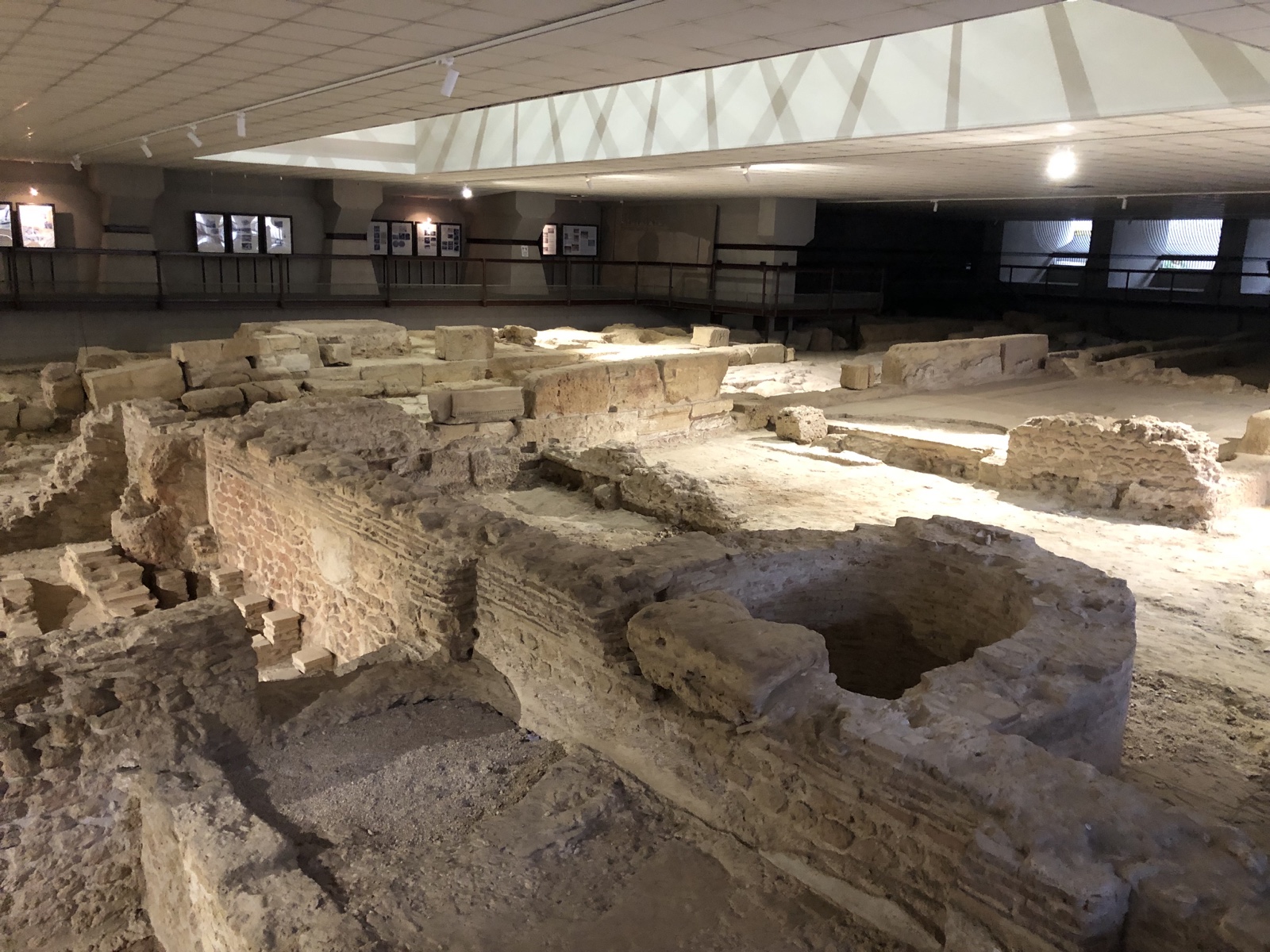
At San Pietro degli Schiavoni, in central Brindisi, two eras share the same space. Above stands the Nuovo Teatro Verdi. Part of the foyer floor is transparent, revealing the excavations. Below lie the remains of a Roman district.
A paved street runs through the district from north to south. It was a cardo, one of the streets that divided the neighbourhood into blocks. Raised pavements border it on both sides. Grooves left by cart wheels remain on the stones. Around the street, low walls and fragments of floors mark the rooms of houses and a bath complex. The district was uncovered during excavations in the 1960s.
Transcript of the essential story (English)
At San Pietro degli Schiavoni, in central Brindisi, two eras share the same space. Above the excavations stands the Nuovo Teatro Verdi. Part of its foyer floor is transparent, allowing a view of the remains below. They belong to a Roman neighbourhood.
A paved street crosses the neighbourhood from north to south. It was a cardo, one of the streets dividing the area into blocks. Raised pavements run along both sides. Ruts left by cart wheels are still visible in the stone slabs. Beside the street, low walls and fragments of flooring mark houses and a bath complex. The excavations brought this neighbourhood to light in the nineteen sixties.
Transcript of the extended story (English)
In Brindisi, the Nuovo Teatro Verdi rises above the remains of a Roman neighbourhood. The auditorium and the archaeological area occupy different levels. In the theatre foyer, part of the floor is made of glass, offering a view from above. The archaeological area also has its own walkway.
Imagine a street paved with large limestone slabs, running from north to south. It is called a cardo because it formed part of the city's street network. Two raised pavements mark the sides of the roadway. On some slabs, the ruts left by cart wheels can still be seen.
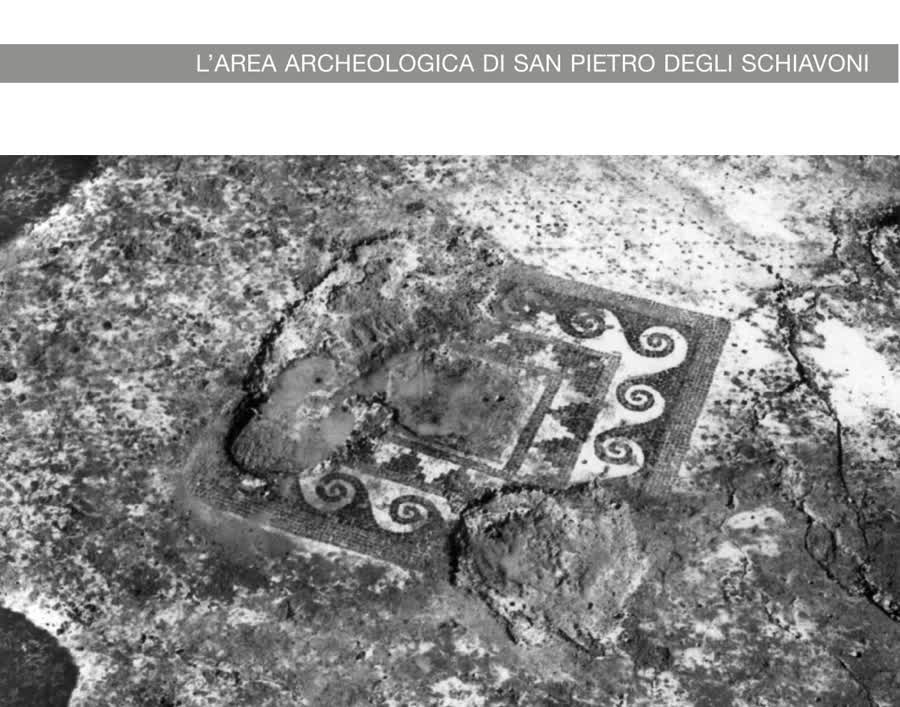
Along the street, walls outline the rooms of Roman houses. The floors help us identify them. Some are mosaics; others are made of cocciopesto, a mixture containing fragments of terracotta. In other rooms, small bricks laid diagonally form a herringbone pattern.
There is also a bath complex. A furnace supplied heat to its rooms. Its remains occupy part of the pavement. This suggests that the neighbourhood changed over time and that the street eventually lost its original function.
The remains came to light during demolitions and excavations between nineteen sixty-four and nineteen sixty-six. The theatre was later designed above the archaeological area. This is why the place has been called a double stage: above, today's stories are performed; below, stones and floors tell the story of an ancient neighbourhood.
Look closer
Two stages, one place
01The street
The cardo crossed the district from north to south. The source gives a carriageway about 4.5 metres wide; about 60 metres survive today. [1]
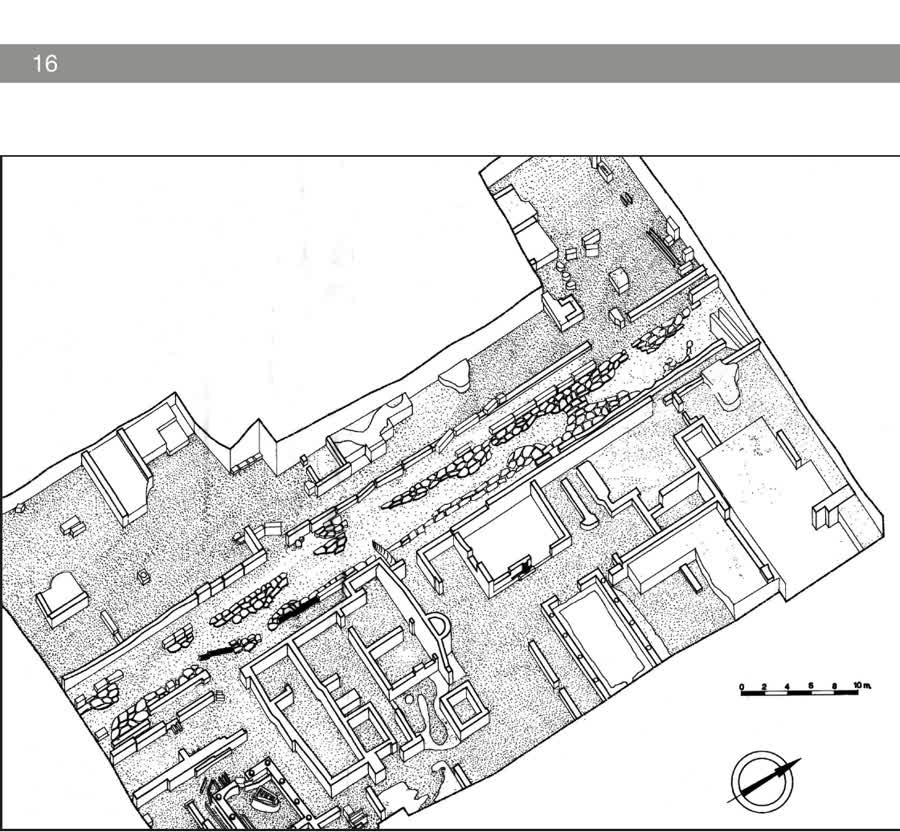
Plan of the excavations
Clean graphic version supplied by the project. Markers show approximate areas, not coordinates of individual finds. See the 1986 survey [1]
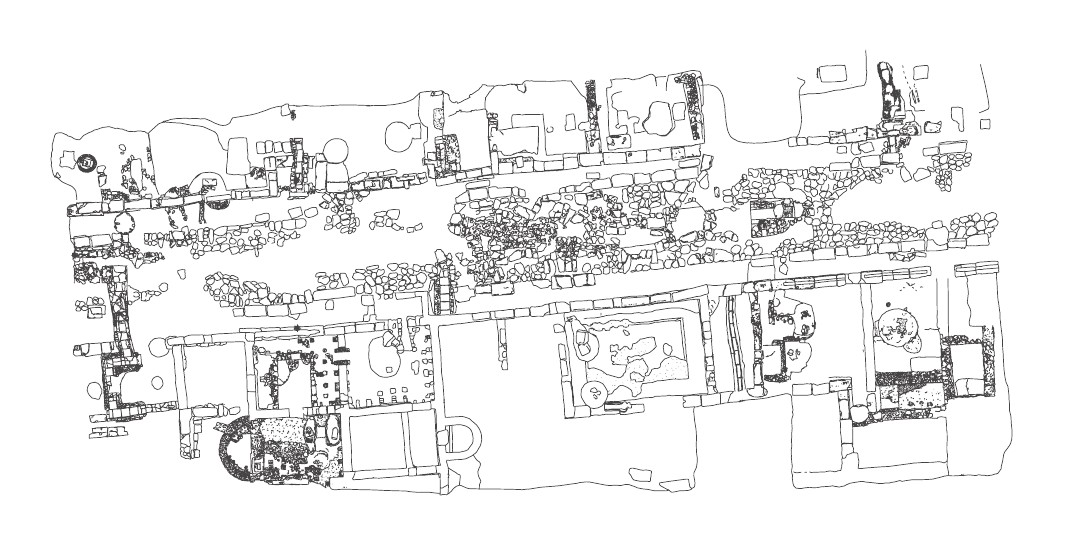
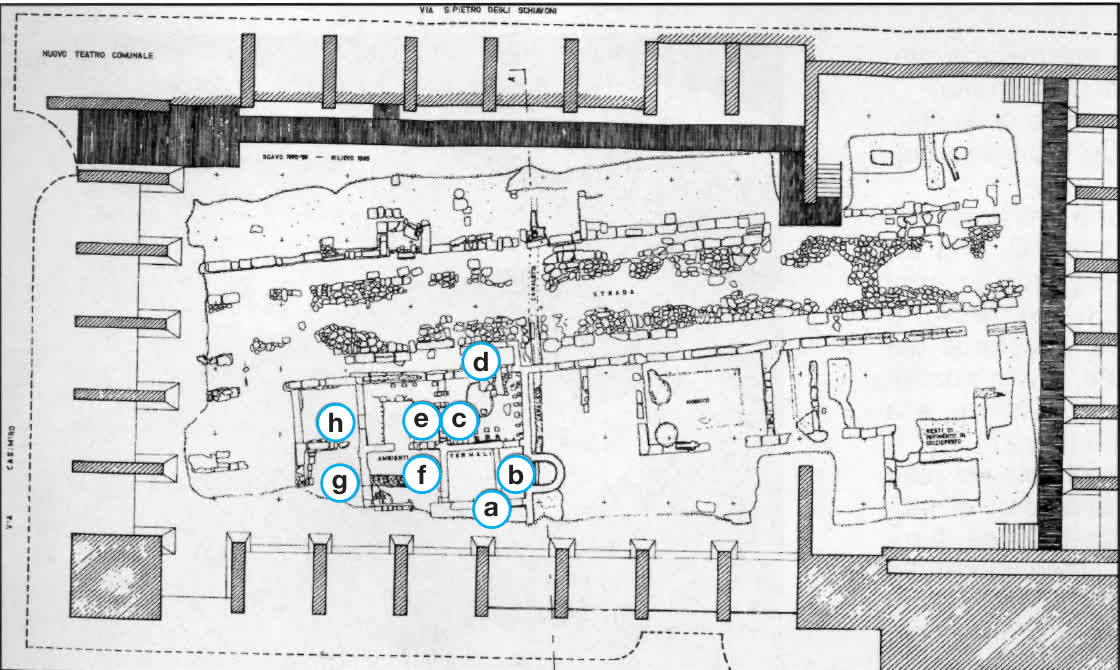
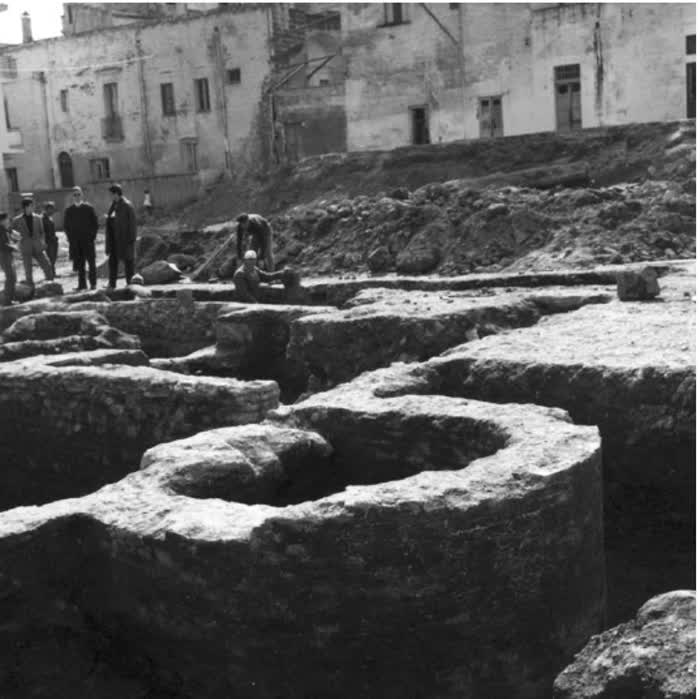
The site in 1964
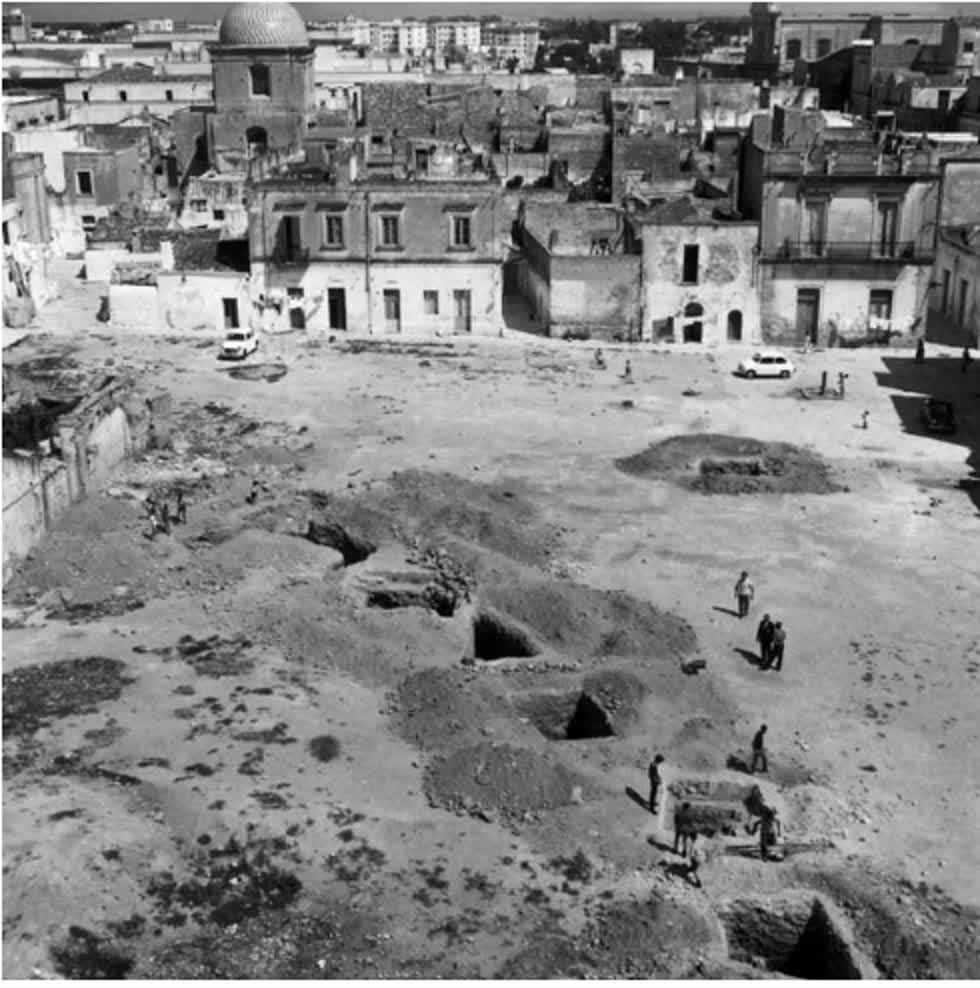
Photograph at the start of the excavation, before the New Municipal Theatre was built. It does not depict the Roman-period appearance of the site.
The medieval phase too
A 1984 trial excavation near vico De’ Balzo recorded medieval walls and pottery. Marinazzo describes disturbed soil without a secure stratigraphic sequence; individual fragments are therefore not placed on the Roman plan. [2]
Bibliography and credits
- Assunta Cocchiaro (ed.), Brindisi romana. L’area archeologica di San Pietro degli Schiavoni, Soprintendenza per i beni archeologici della Puglia, undated in the supplied PDF, pp. 15–21, figs. 18, 20–22, 28. Figure 28 is the plan made in 1986. Final photo credits name the Soprintendenza photographic archive, the Italian Air Force and the Provincial Museum of Brindisi, without naming the photographer of fig. 18.
- Angela Marinazzo, ‘Saggio nell’Area di San Pietro degli Schiavoni a Brindisi (1984)’, Brundisii Res, XIV, 1988, pp. 73–83. The vico De’ Balzo trial excavation is distinct from the Roman sector below the theatre; p. 74 credits the article’s photographs to Giuseppe Pennetta.
- BrindisiWeb, ‘Area Archeologica di San Pietro degli Schiavoni’, a comparison source with a 1965 photograph and bibliography. Its images are not reproduced here. BrindisiWeb.
Clean plan: graphic file supplied by the project (“1) PIANTA Scavi pulito.pdf”); no creator named in the file. The 1986 archaeological survey remains linked above.
Reproductions from the Soprintendenza booklet, published with online reuse authorisation declared by the project owner on 9 November 2026.
Sources and credits for this stop
Visiting the site
Before visiting, check access to the excavations and foyer with the municipality or Teatro Verdi. This preview does not provide up-to-date opening hours.
Content sources
Photograph and licence
Photograph: Gaiaanelli, 2022 · CC BY-SA 4.0. Cropped for layout only. English narration generated locally with Piper Cori medium, voice of Cori Samuel. Hi-Fi Multi-Speaker English TTS Dataset, NVIDIA Corporation · CC BY 4.0.
Gaiaanelli · Wikimedia Commons · CC BY-SA 4.0

Each stop lists its sources and distinguishes documented remains from interpretation. Availability of a digital guide does not confirm access to the physical site.